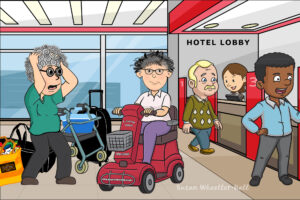
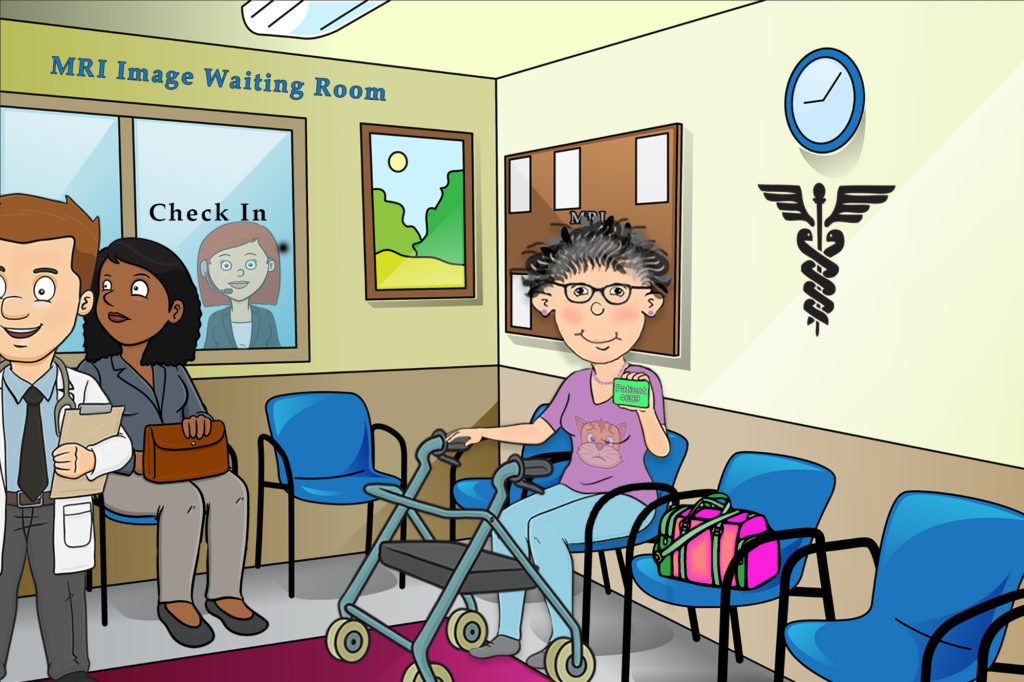
Tests, tests, and more tests, UGH! The one thing you learn from spending time in medical “waiting” rooms is how to be patient – or rather – how to be a patient. I don’t how many hours of my life have been spent in waiting rooms but it must be a very large number by now.
As a youngster, it did not take me long to comprehend why people are referred to as “patients”. However, I must say that after observing the behaviour of people of all ages in waiting rooms, impatient’s would be a more accurate term of reference. Then again, labels do help to imply expected behaviour, so that must be why the term patient was selected.
This week I went with Sweet Pea to the hospital for a test that she required. We do that sort of thing together now, but that was not always the case for me. Most of my life I managed my medical administrative tasks on my own.
Given that my particular disease is somewhat ambiguous, and progressive, I knew I’d be a frequent flyer of waiting rooms, and yes, this is where I mastered the art of being a patient… patient.
There is no instructional manual on how to experience waiting rooms happily, so I made up my own version.
Of course, I do the usual things such as take a book or magazine sometimes, but early on I created feel-good rituals reserved just for waiting rooms. For example, I really enjoy the candy roll called “Life Savers” (named appropriately) so I would take along two rolls of colourful yummy delights. I also had a stockpile of pocket-sized booklets of “easy” crossword puzzles. They had to be easy because my goal was not to challenge or frustrate myself but rather to enjoy the checkmark I awarded each completed puzzle. Two by two was my motto (one puzzle, one Life Saver).
Now that I think about it, I did follow a game-like model too, where my aim was to complete the puzzle before the candy in my mouth disintegrated. This guilty-pleasure worked well for what I term “level one medical waiting” situations. And, if you spend any time at large hospitals (as I did/do) then you can depend on level one waits to be lengthy.
Level two medical waiting situations pose more of a problem because at this level, personal items are not permitted and that often includes clothing. Except for your underpants, you’re reduced to wearing fabric or a ghastly paper gown. X-rays, scans and other noninvasive and invasive procedures fall into this category. Being stripped (pun intended) of distraction aids elevates the challenge to remain patient and calm.
For this level, I surmised that my mind had to help me and not hinder me by becoming unhinged. At these times I mentally connected with my mother. She died when I was a child so I found it helpful to save this exercise for when I felt most challenged. Let’s face it, the second level of medical waiting can be a lonely and frightening emotional trigger and that’s how I kept it in check.
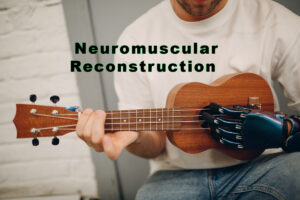
Essentially, I gave my mother a life progress report with thoughtful descriptions of what I’d been doing. I told her what it was like to go on an airplane, as she had not had the chance to do so; I told her about new inventions that had occurred such as the microwave, computer and cell phone. Mostly, I just described the aids that help me thrive despite my disability. I reassured her that I was doing well and shared a positive perspective about my life with a disability. This internal dialogue kept my thoughts in a good frame of reference.
Now, you may have already figured this out, but given that I created these rituals when I was a child, it took me many years to see that I was actually reassuring myself.
It is difficult to remain calm when you feel medically vulnerable. I’m thinking of times waiting for surgery, or enduring tests that could have potentially life-changing outcomes, as well as the mundane hours of recovery.
The quiet can be deafening and overwhelming and that’s when we need all-hands-on-deck.
Our loved ones, whether present or not, want to help us. With our minds, we can help them to help us. It sure helps me.
Who might you talk with in your thoughts?